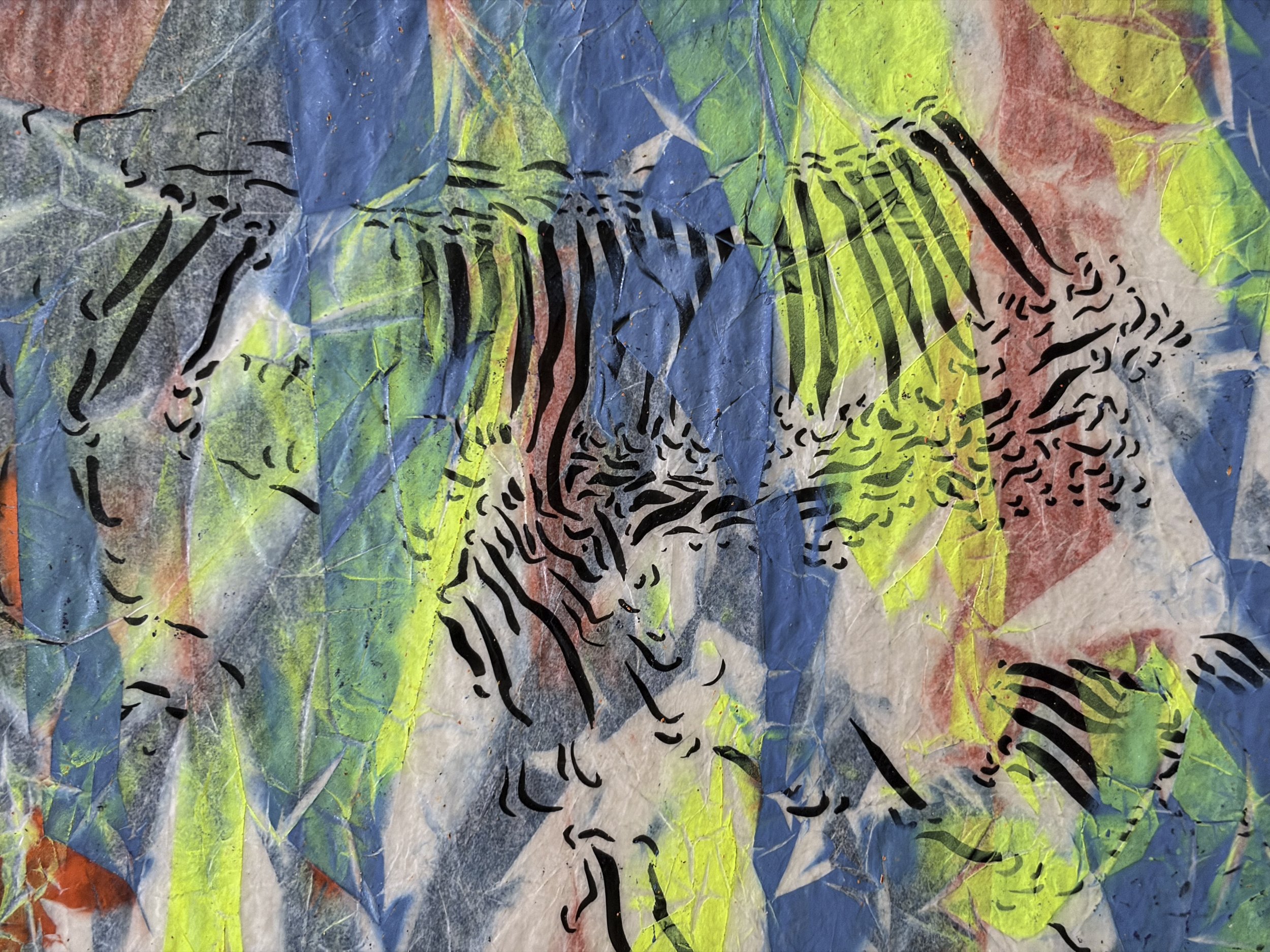
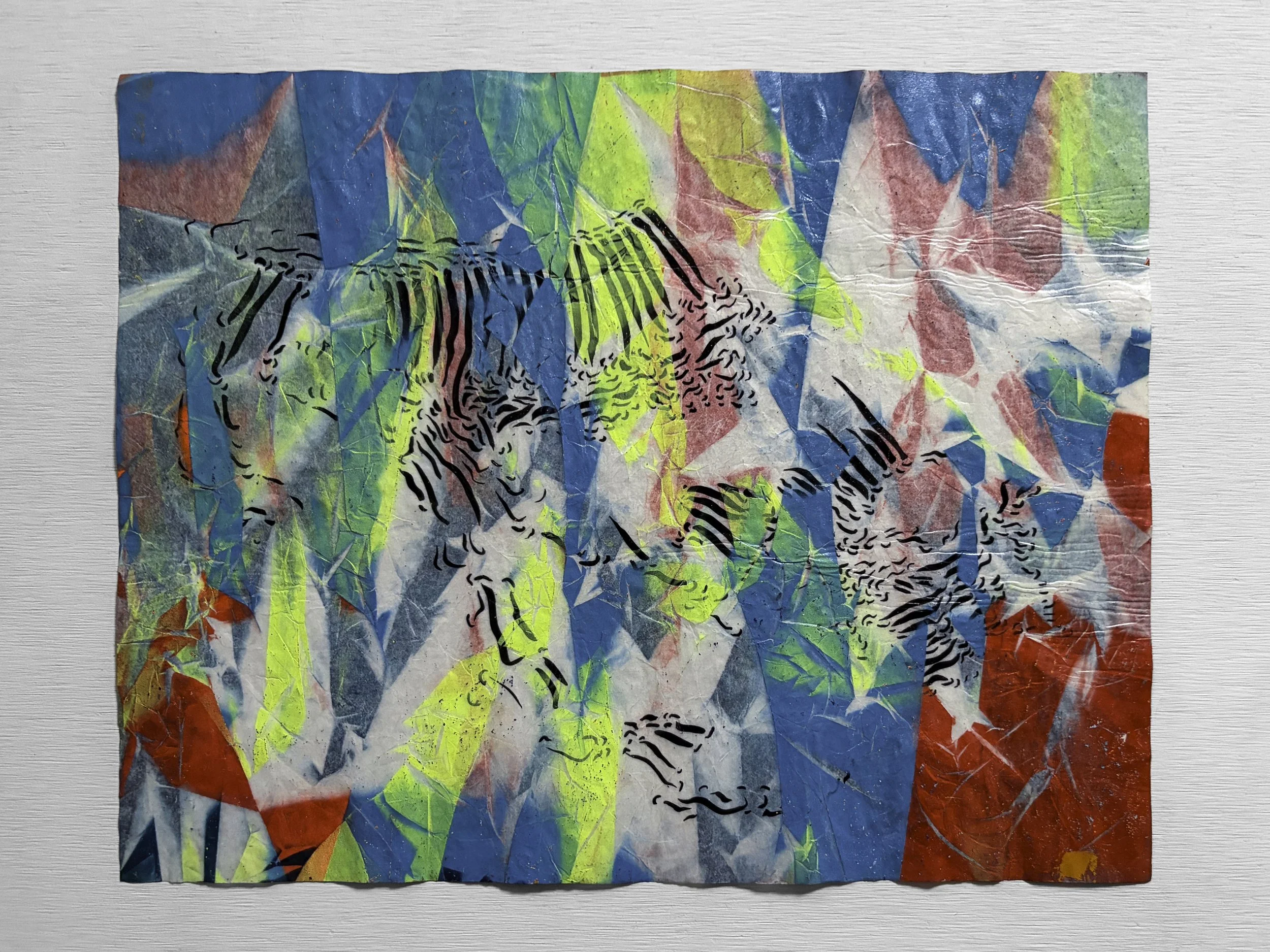
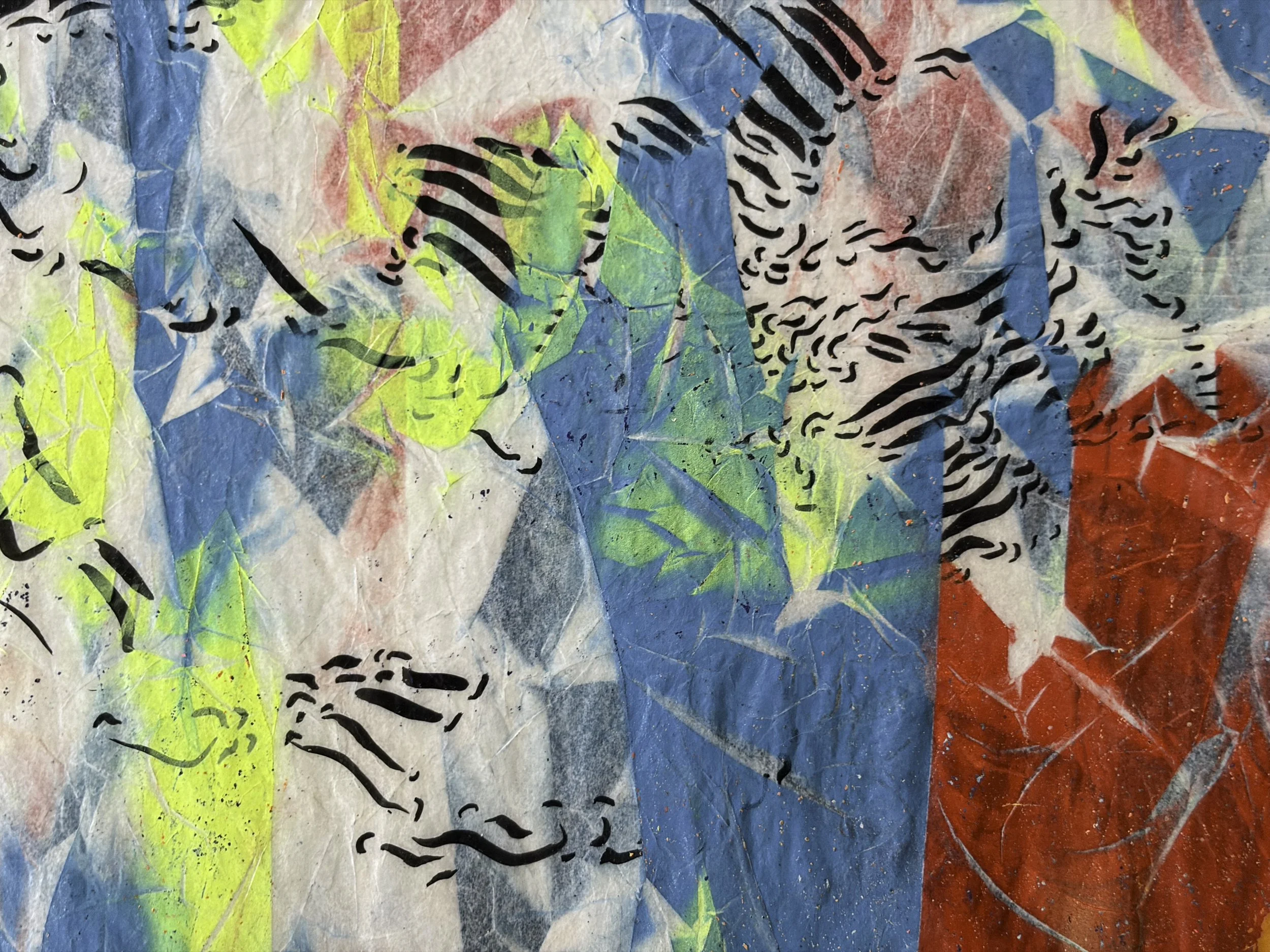
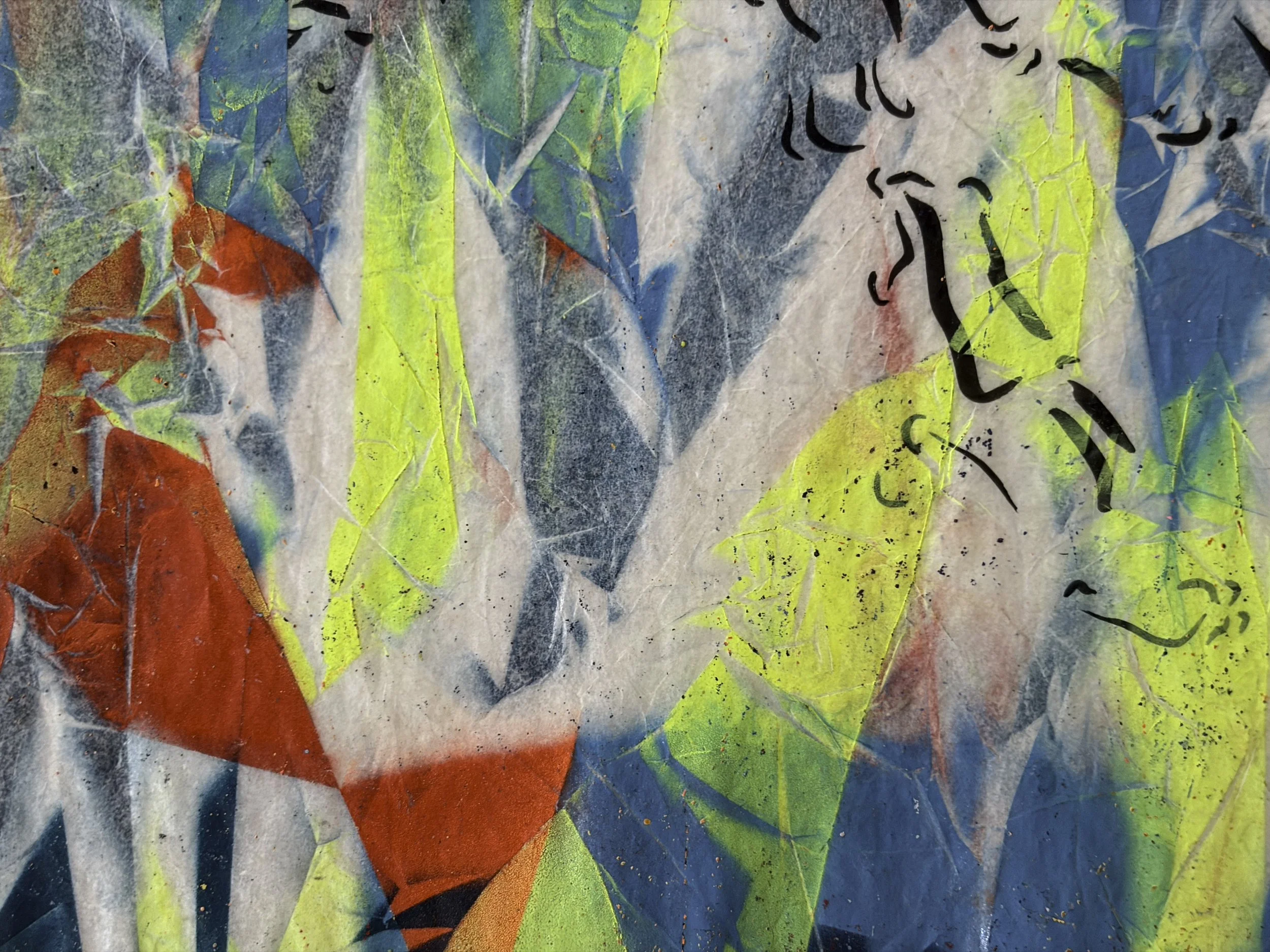
Above: Surprise, Surprise No. 9 carries the drama of water and weather in motion. The image feels like a landscape caught between the arrival and departure of a powerful force: a storm approaching, a wave retreating, or a shoreline revealing what has been left behind after a moment of transformation.
The large black drawing marks dominate the surface with a force that feels both abstract and alive. They can suggest figures, animals, delicate bone structures, or forms rearranged into motion. Like a woodblock print, the lines have a graphic clarity and physical presence, creating an image where every mark carries weight.
The translucent layers of blue, white, and yellow fluorescent color create the sensation of light passing through atmosphere. At moments the work suggests water; at others, the luminous shifting colors of northern lights, storm light, or a landscape seen through rain. It remains suspended between growth and decay, emergence and disappearance.
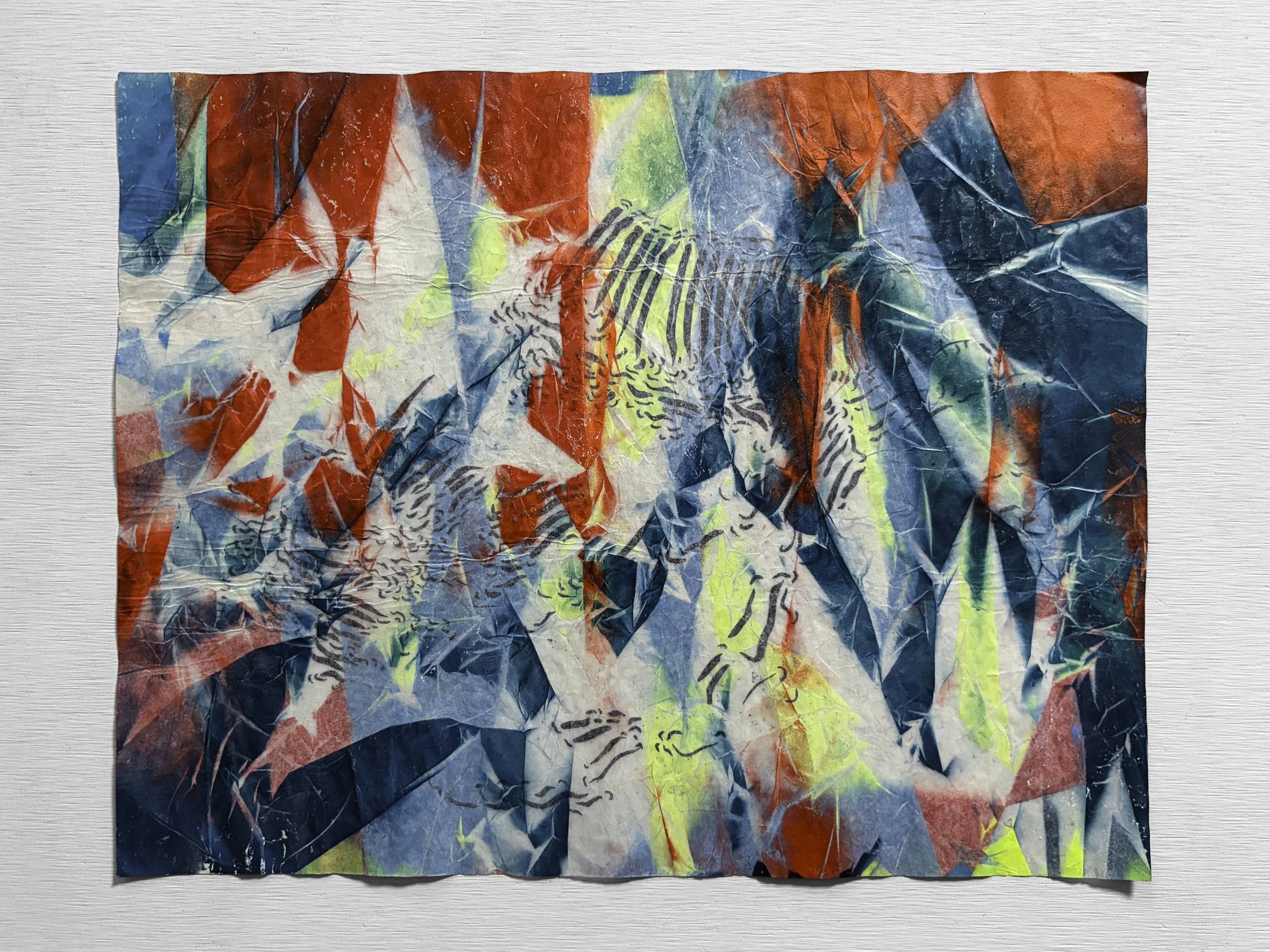
Below: The reverse surface intensifies the elemental quality of the work. The composition feels more expansive and turbulent, suggesting a vast storm system, a jungle caught in extreme weather, or the immense force of a wave approaching from a distance.
The relationship between the two sides recalls the changing views of a single event: the overwhelming force before impact and the quiet aftermath afterward. The hidden colors and transferred marks create the feeling of an image continually changing, like memory, weather, or water itself.
The work carries an echo of Hokusai’s ability to transform natural forces into images of movement and emotion. The water is not simply water; it becomes a language for uncertainty, beauty, danger, and awe.
Reflection: Surprise, Surprise No. 9 explores the visual memory of forces that cannot be fully controlled or contained. Water, storms, waves, and landscapes shaped by weather have always carried a particular power because they exist between stability and change.
The process of folding, pressing, transferring, and reopening the tracing paper mirrors that instability. The image is built through repeated transformations, where marks are interrupted, relocated, and revealed in unexpected relationships. Like a dream or a remembered scene, it holds onto fragments rather than a single fixed reality.
The work asks how images of nature become emotional experiences. A wave can be both beautiful and threatening; a storm can be both destruction and renewal. Surprise, Surprise No. 9 exists in that space between observation and imagination, where the natural world becomes something larger than itself.
Above: Surprise, Surprise No. 9 carries the drama of water and weather in motion. The image feels like a landscape caught between the arrival and departure of a powerful force: a storm approaching, a wave retreating, or a shoreline revealing what has been left behind after a moment of transformation.
The large black drawing marks dominate the surface with a force that feels both abstract and alive. They can suggest figures, animals, delicate bone structures, or forms rearranged into motion. Like a woodblock print, the lines have a graphic clarity and physical presence, creating an image where every mark carries weight.
The translucent layers of blue, white, and yellow fluorescent color create the sensation of light passing through atmosphere. At moments the work suggests water; at others, the luminous shifting colors of northern lights, storm light, or a landscape seen through rain. It remains suspended between growth and decay, emergence and disappearance.
Below: The reverse surface intensifies the elemental quality of the work. The composition feels more expansive and turbulent, suggesting a vast storm system, a jungle caught in extreme weather, or the immense force of a wave approaching from a distance.
The relationship between the two sides recalls the changing views of a single event: the overwhelming force before impact and the quiet aftermath afterward. The hidden colors and transferred marks create the feeling of an image continually changing, like memory, weather, or water itself.
The work carries an echo of Hokusai’s ability to transform natural forces into images of movement and emotion. The water is not simply water; it becomes a language for uncertainty, beauty, danger, and awe.
Reflection: Surprise, Surprise No. 9 explores the visual memory of forces that cannot be fully controlled or contained. Water, storms, waves, and landscapes shaped by weather have always carried a particular power because they exist between stability and change.
The process of folding, pressing, transferring, and reopening the tracing paper mirrors that instability. The image is built through repeated transformations, where marks are interrupted, relocated, and revealed in unexpected relationships. Like a dream or a remembered scene, it holds onto fragments rather than a single fixed reality.
The work asks how images of nature become emotional experiences. A wave can be both beautiful and threatening; a storm can be both destruction and renewal. Surprise, Surprise No. 9 exists in that space between observation and imagination, where the natural world becomes something larger than itself.