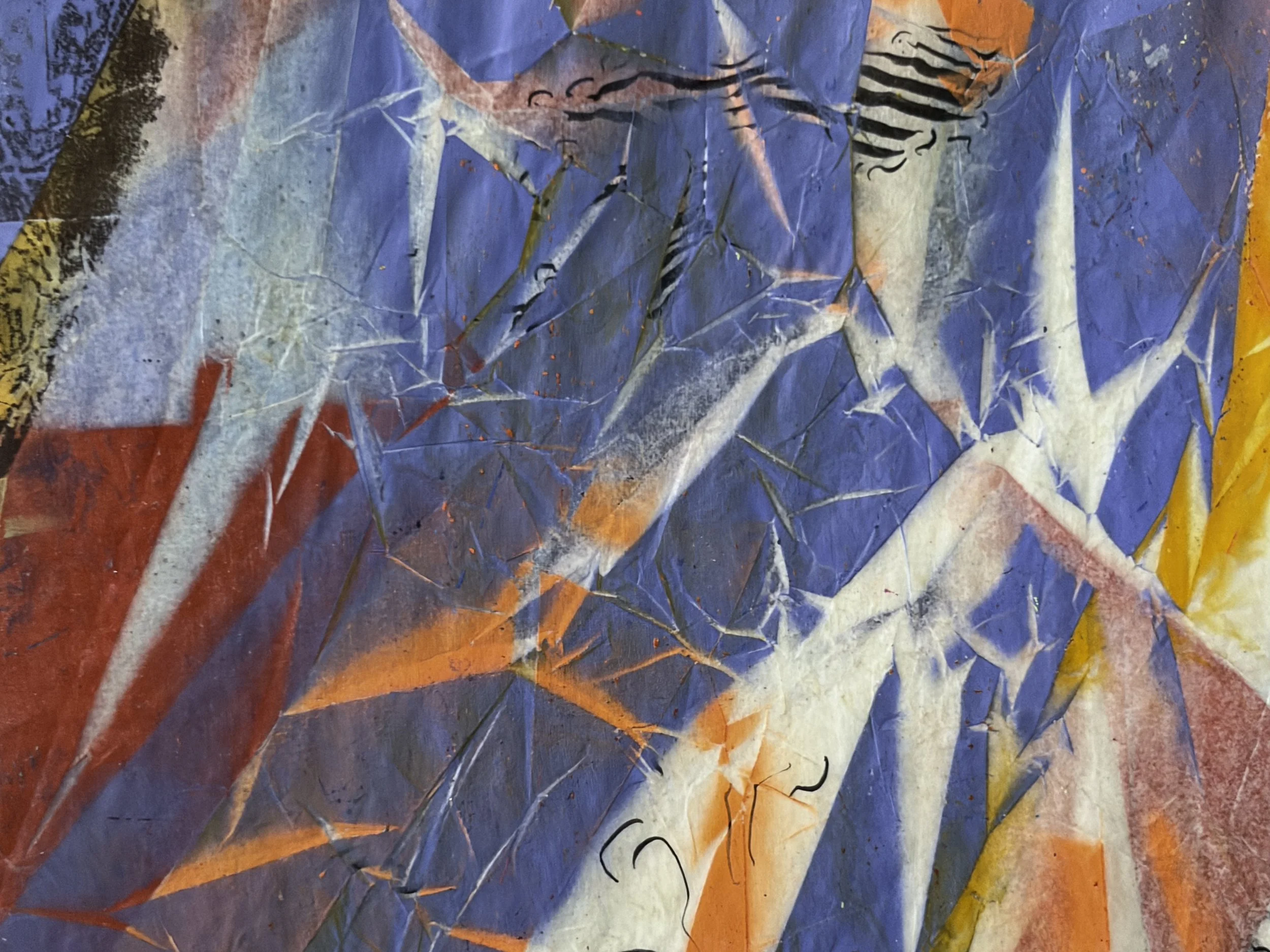
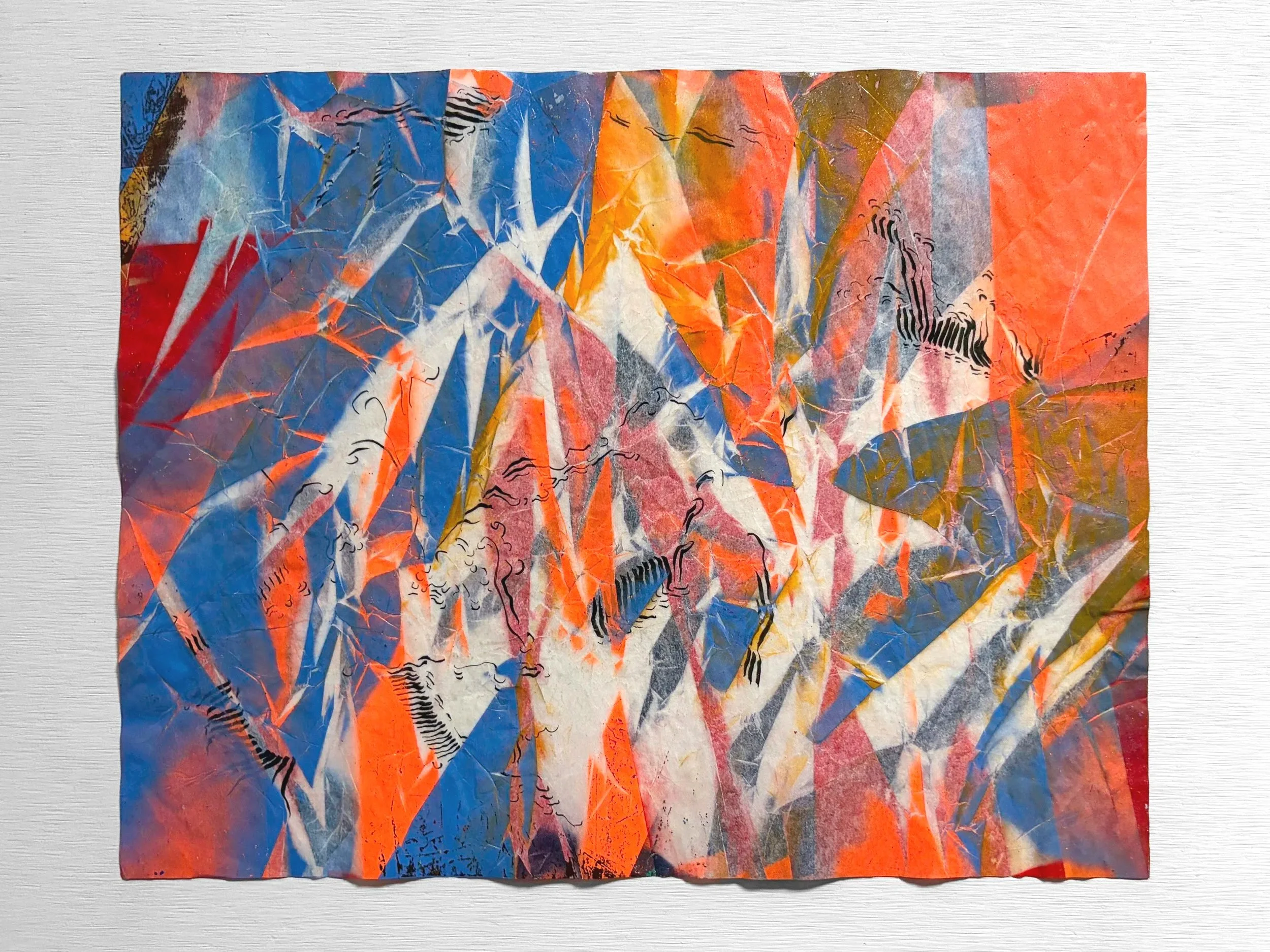
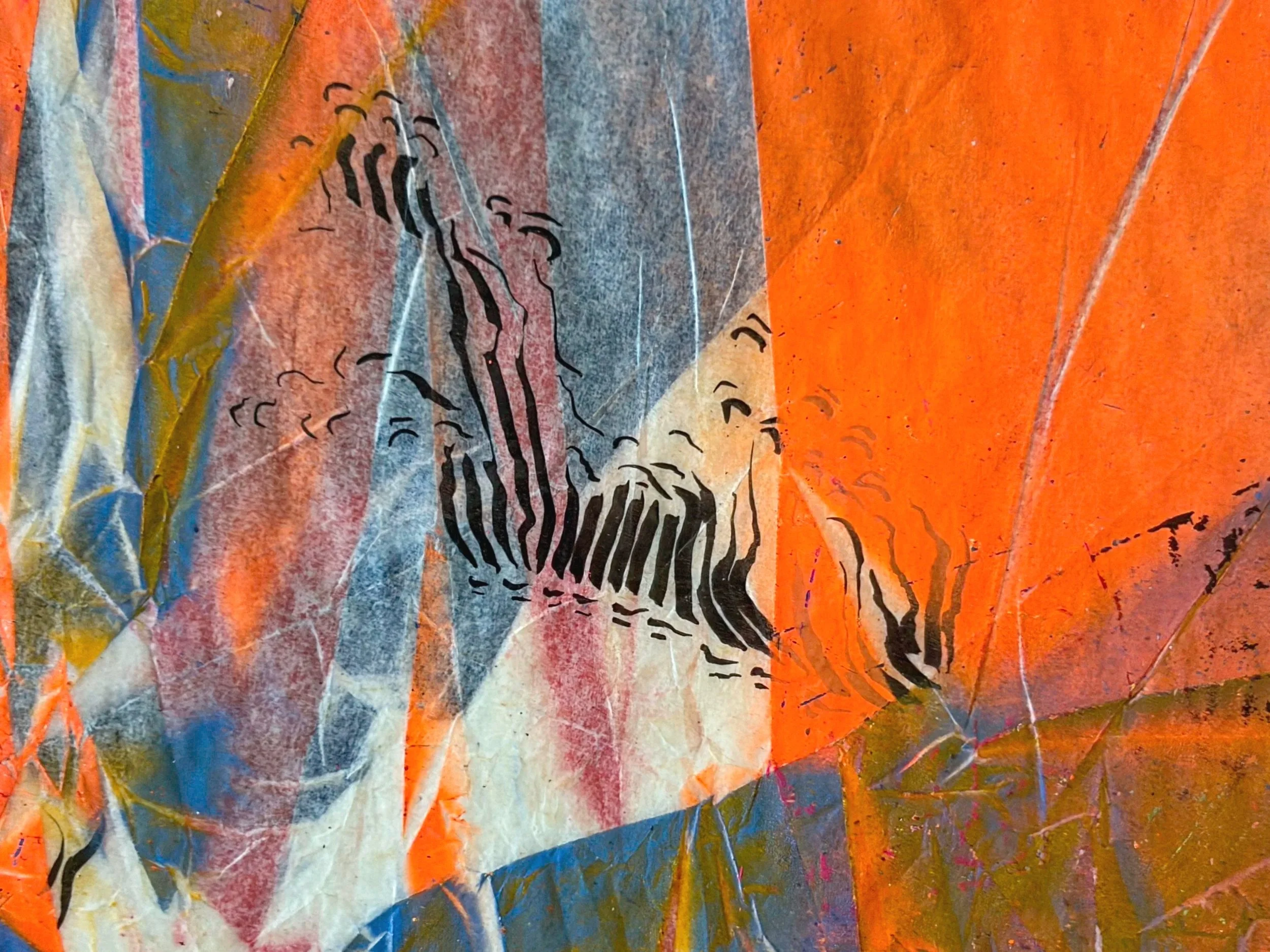
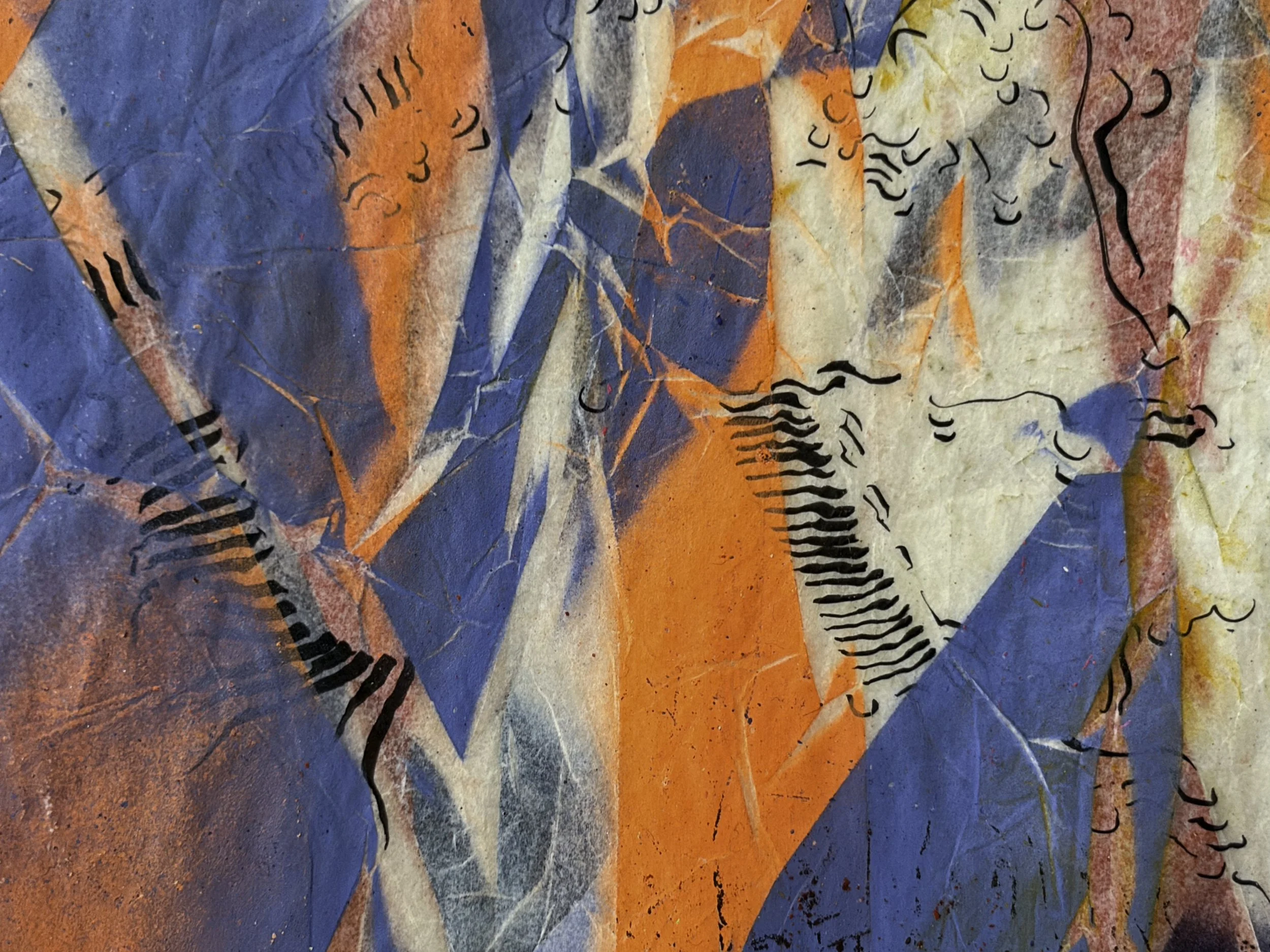
Above: Surprise, Surprise No. 14 opens into a deep blue atmospheric space where small delicate marks appear suspended like fragments of life, movement, or memory. The blue field creates a sense of distance and depth, while flashes of orange introduce warmth and energy, activating the space like sunlight breaking through a cold environment.
The drawing feels delicate but intentional, almost like a small ecosystem existing within a larger field. White passages become active forms rather than empty space, suggesting shards of ice, floating fragments, or openings within a vast environment. The work balances stillness and movement, creating the feeling of a landscape remembered rather than directly observed.
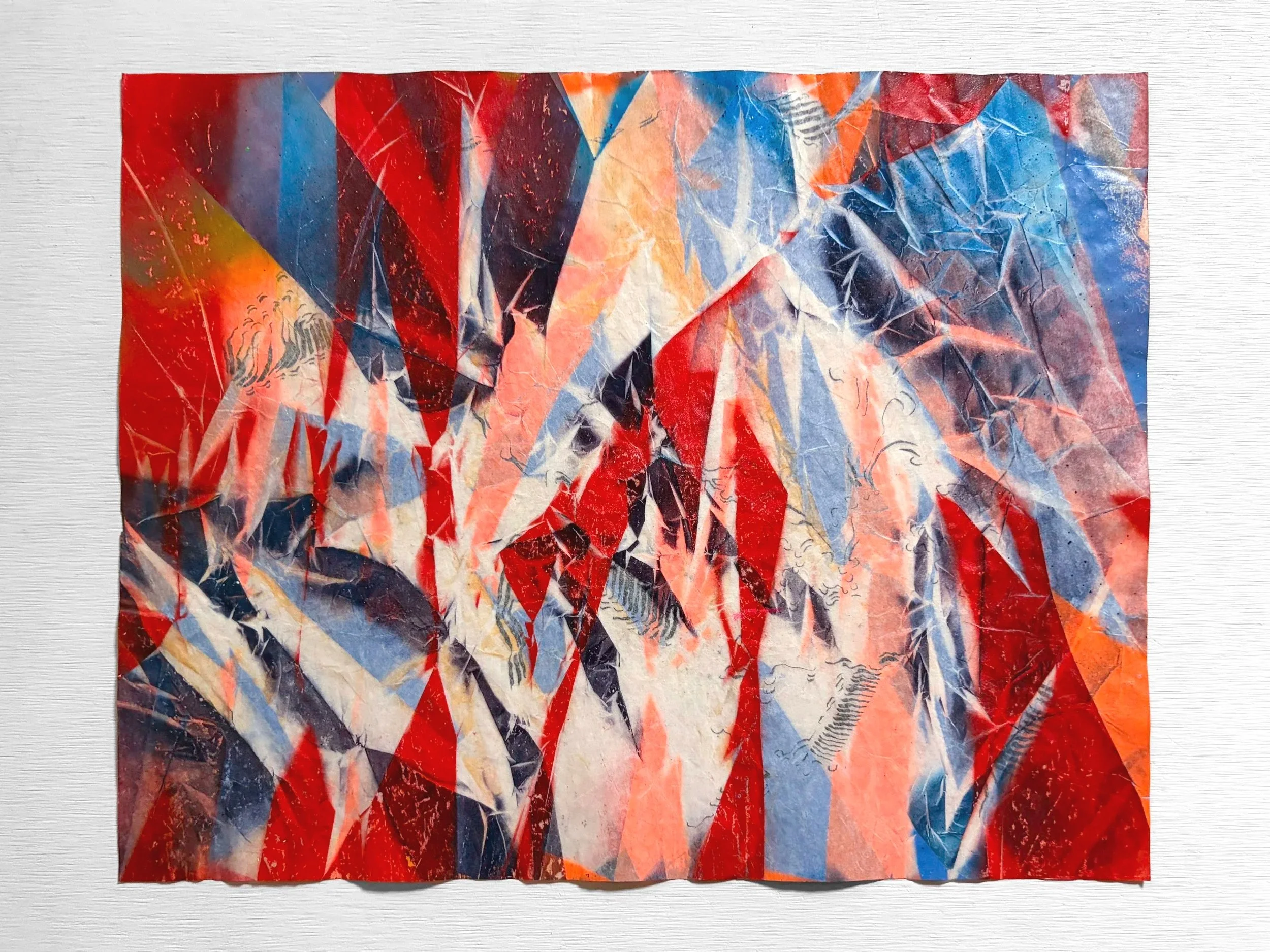
Below: The reverse surface reveals the hidden architecture beneath the apparent simplicity of the Above view. Darker blues, burgundy reds, and deeper color fields transform the work into a more spatial and immersive environment, suggesting a winter woodland path covered with heavy snow, branches bending beneath accumulation, or a landscape viewed through another atmosphere.
The relationship between the two sides is especially striking: what appears relatively flat from one perspective becomes unexpectedly dimensional from another. Layers of transferred color create depth, volume, and distance, revealing how much hidden structure exists beneath the surface.
Reflection: Surprise, Surprise No. 14 explores how perception changes when an image is encountered from another side. The work is a reminder that surfaces are rarely as simple as they appear; hidden layers, buried colors, and previous states remain active within the final image.
The process of folding, transferring, and reopening the tracing paper creates a space where two realities coexist. One side presents a quiet atmospheric field, while the other reveals the accumulated history that creates its depth and complexity.
Like a dream, a memory, or a cinematic dissolve, the image shifts between states without fully resolving. The viewer is invited to move between the visible and the hidden, the flat surface and the imagined space behind it.
Above: Surprise, Surprise No. 14 opens into a deep blue atmospheric space where small delicate marks appear suspended like fragments of life, movement, or memory. The blue field creates a sense of distance and depth, while flashes of orange introduce warmth and energy, activating the space like sunlight breaking through a cold environment.
The drawing feels delicate but intentional, almost like a small ecosystem existing within a larger field. White passages become active forms rather than empty space, suggesting shards of ice, floating fragments, or openings within a vast environment. The work balances stillness and movement, creating the feeling of a landscape remembered rather than directly observed.
Below: The reverse surface reveals the hidden architecture beneath the apparent simplicity of the Above view. Darker blues, burgundy reds, and deeper color fields transform the work into a more spatial and immersive environment, suggesting a winter woodland path covered with heavy snow, branches bending beneath accumulation, or a landscape viewed through another atmosphere.
The relationship between the two sides is especially striking: what appears relatively flat from one perspective becomes unexpectedly dimensional from another. Layers of transferred color create depth, volume, and distance, revealing how much hidden structure exists beneath the surface.
Reflection: Surprise, Surprise No. 14 explores how perception changes when an image is encountered from another side. The work is a reminder that surfaces are rarely as simple as they appear; hidden layers, buried colors, and previous states remain active within the final image.
The process of folding, transferring, and reopening the tracing paper creates a space where two realities coexist. One side presents a quiet atmospheric field, while the other reveals the accumulated history that creates its depth and complexity.
Like a dream, a memory, or a cinematic dissolve, the image shifts between states without fully resolving. The viewer is invited to move between the visible and the hidden, the flat surface and the imagined space behind it.